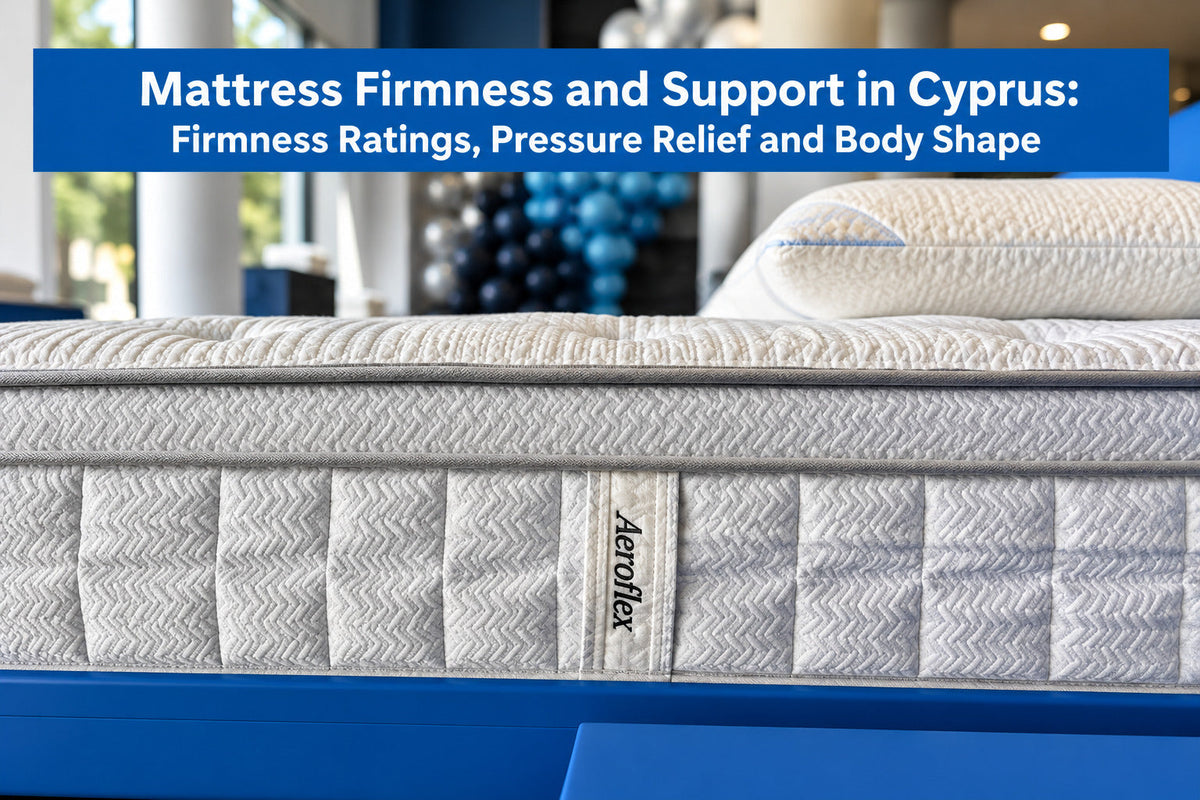
Mattress firmness controls pressure relief at the shoulders and hips, while mattress support holds spinal alignment. Consumer firmness ratings rise from soft to firm, but the European HS scale marks 1 as firmest and 10 as softest.
Heavier sleepers need a firmer support core, and body shape decides where the shoulders, waist and hips need softer or firmer support. Medium-firm mattresses suit adults with lower-back discomfort, and shoppers in Cyprus confirm the fit by lying in their usual sleeping position.
What are mattress firmness and support?
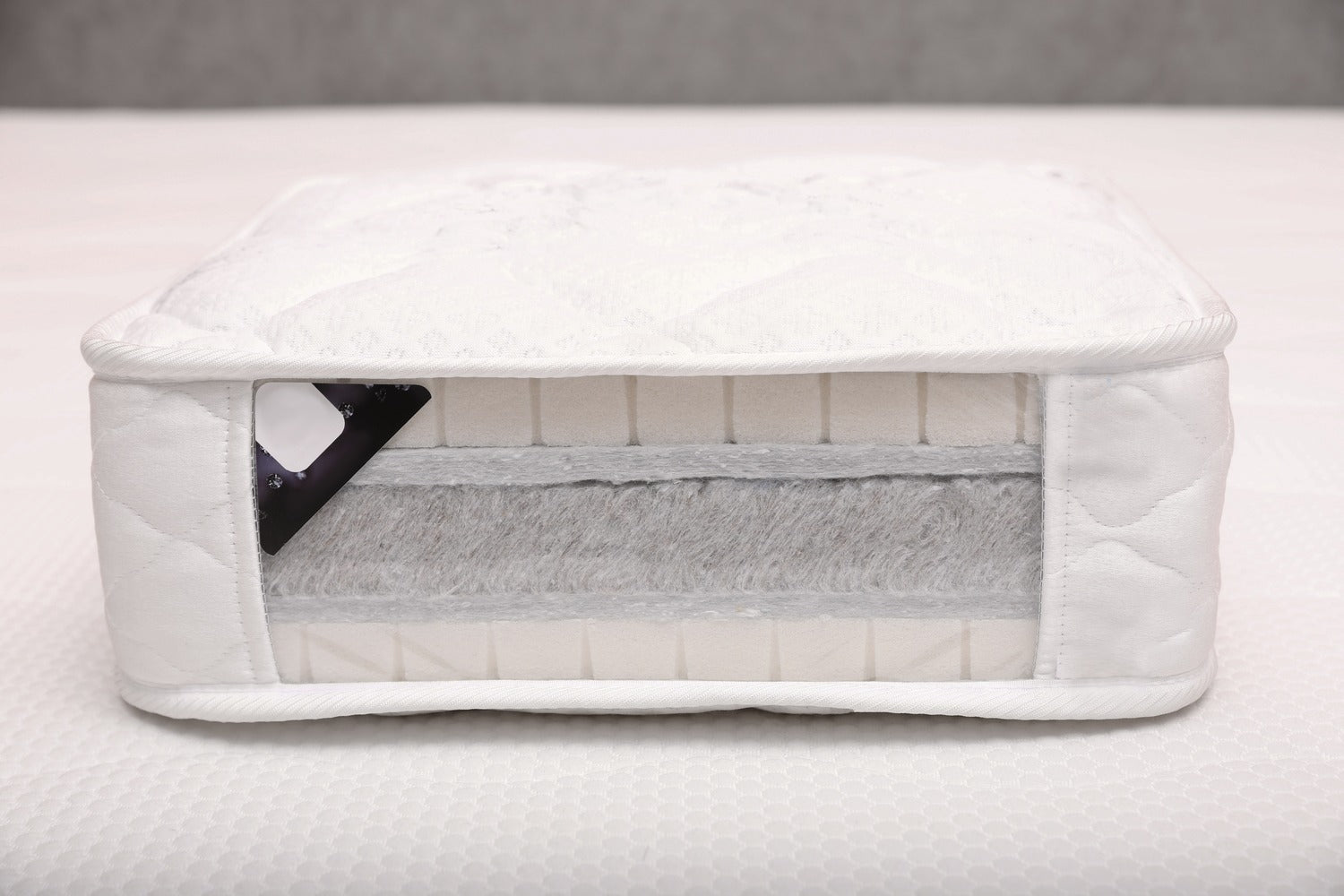
Mattress firmness is how the sleeping surface feels under body weight, mainly set by the comfort layers, while mattress support is how the mattress keeps your spine in line, mainly set by the support core beneath them. Firmness and support work together in all mattresses, so a soft-feeling surface can still keep your spine in line. The comfort layer sits above the support core and produces the first sensation of contact.
The support core sits beneath the comfort layer and resists deeper compression. A mattress with a soft top layer can still carry firm support underneath, because firmness comes from the comfort layer and support from the core. Judging a mattress by surface feel alone overlooks the support core, which controls spinal alignment.
How do comfort layers and support cores affect firmness and support?
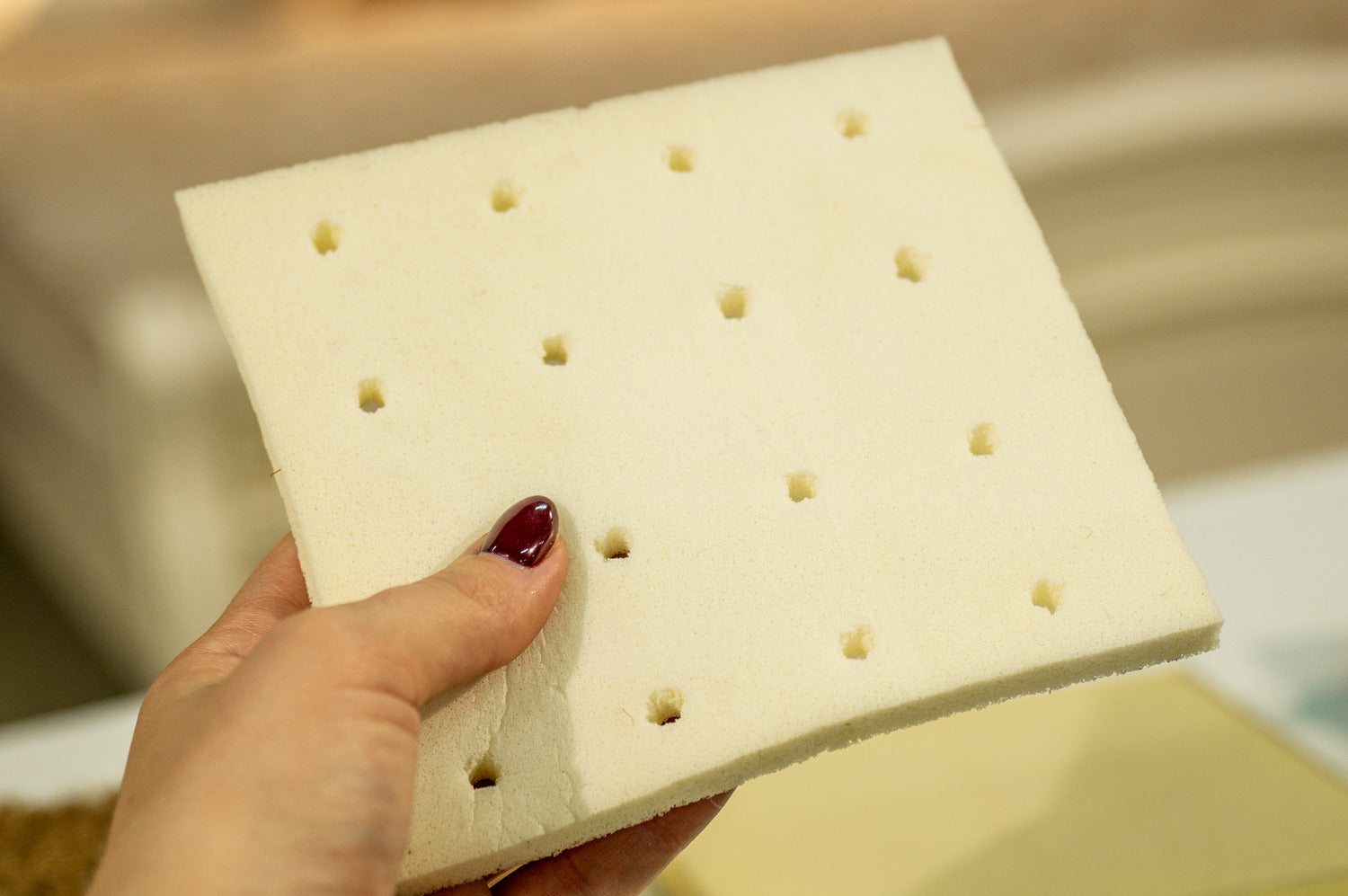
Comfort layers set the surface feel and pressure relief, while the support core carries body weight and controls how deeply the hips and shoulders sink. Foam, latex and fibre each produce a distinct comfort-layer feel. Foam softens gradually and contours closely to the body's shape. Latex rebounds faster and sinks less.
Fibre adds a lighter, more buoyant surface layer. Beneath these materials, the support core, built from pocket springs or a foam block, determines how far the body sinks overall. A soft comfort layer paired with a firm core produces a cushioned surface with controlled depth. Mattress performance always reflects how both parts work together.
How is mattress firmness measured?
Mattress firmness is measured by how far the surface indents under a set load, and firmness scales express the result as a label or number, which compares reliably only between mattresses rated on the same scale. A deeper indentation under the same load indicates a softer surface. Repeated loading shows how much firmness and height a mattress loses with use.
Word labels such as soft, medium, medium-firm and firm describe general firmness bands. Numbered consumer scales rise from soft at the low end to firm. The European HS rating reverses that order, marking 1 as firmest and 10 softest. On the HS scale, 3 is firm, while 3 on a consumer scale is soft. Checking a scale's direction prevents a misleading comparison between two mattresses.
How does mattress support affect spinal alignment?
Mattress support keeps the spine in a neutral line by controlling how deeply the hips, shoulders and trunk sink, and each sleeping position changes where that support must act. A neutral spine keeps the natural curves of the neck, upper back and lower back intact. Support must resist sinking at the hips and shoulders to maintain those curves.
Sleeping position changes where the hips and shoulders press against the mattress. Side sleeping shifts the load onto the shoulder and hip. Back sleeping shifts the load onto the pelvis and the base of the spine. One support core must therefore carry both the loads from side and back sleeping.
How does mattress sinkage affect spinal alignment?
Mattress sinkage keeps the spine aligned when the hips and trunk sink to the same depth as the rest of the body, and it bends the spine when the pelvis sinks deeper. Even sinking keeps the shoulders, waist and hips at one consistent depth. A surface too soft for the sleeper's weight lets the pelvis drop below the shoulders. That drop pulls the lower spine out of its neutral line.
A surface too firm for the sleeper's weight produces the opposite fault. The firm surface resists sinking at the waist while the shoulders and hips still compress. That resistance lifts the waist and arches the lower back upward. Surface compression, the give at first contact, differs from deep support, the resistance that holds the hips and shoulders at a consistent depth.
How does sleep position affect mattress support?
Sleep position changes where the mattress must support the body and how firmly: side sleepers need give at the shoulders and hips with firm support at the waist, back sleepers need firm support beneath the lower back, and stomach sleepers need firm support that holds the pelvis level with the chest. Side sleeping presses the shoulder and hip deepest into the mattress.
For back sleepers, the lumbar curve leaves a gap that firm support must fill. A soft surface lets a stomach sleeper’s pelvis sink below the chest. Combination sleepers move between side, back and stomach positions during the night. A combination sleeper’s mattress must support the shoulders, hips, lower back, and pelvis.
How does mattress firmness influence pressure relief?
Mattress firmness determines how evenly body weight spreads across the surface; pressure points form at the shoulders, hips, and base of the spine, and materials and support zones control how that pressure spreads. Pressure relief spreads body weight over a larger contact area instead of concentrating it at the shoulders and hips.
A larger contact area reduces the force applied at any single point on the skin. Pressure points form where the body's bony structures, the shoulder and hip, press most directly into the surface. Uneven loading concentrates pressure at those bony points instead of spreading the load. Concentrated pressure at a bony point causes discomfort that prompts you to turn during sleep. Side sleeping concentrates pressure most heavily at the shoulder and hip. Back sleeping concentrates pressure most heavily at the base of the spine.
Materials and support zones determine how firmness translates into pressure relief across the surface. Memory foam softens with body heat and weight, contouring to the body's shape. Latex springs back as soon as you lift pressure, giving a more responsive surface than memory foam. Pocket springs respond point by point, so each spring compresses independently under localised weight.
Hybrid mattresses combine springs with foam or latex, pairing point-by-point response with a contouring surface layer. Zoned designs place softer support beneath the shoulders and firmer support beneath the hips. Zoning lets one mattress cushion the shoulders and support the hips along its length. Side sleepers benefit from contouring memory foam in the shoulder zone. Back sleepers benefit from a lower-back zone firmer than the shoulder zone.
How do body weight and shape affect mattress firmness and support?
Body weight determines how deeply a mattress compresses, and body shape determines where the shoulders, waist, and hips need softer or firmer support. Body weight and body shape act independently on the same mattress.
Heavier and lighter sleepers feel different firmness levels on one identical mattress. Wide shoulders and narrow hips need different support than a straight profile. Shape therefore decides where along the body the mattress must adjust compression. Together, weight and shape determine how well a mattress suits each sleeper.
How does body weight change perceived mattress firmness?
Greater body weight compresses a mattress further into its support core, so a heavier sleeper feels a softer surface on the same mattress than a lighter sleeper. Lighter sleepers press into the comfort layers and stop short of the support core.
This shallower compression makes the surface feel firmer for a lighter body. Heavier sleepers reach the support core, so the same firmness rating feels softer. Heavier sleepers need a firmer core than lighter sleepers to stay level. That firmer core stops the hips and shoulders sinking out of spinal alignment.
How does body shape change mattress support needs?
Wide shoulders, a narrow waist or broad hips change where the mattress must cushion contact points and fill gaps, so different body shapes need support in different places. A wide shoulder-to-hip ratio increases shoulder contact when you sleep on your side.
A narrow waist leaves a gap between the mattress and the sleeper's side. That waist gap needs filling to keep your spine level while sleeping on your side. A pronounced lower-back curve needs a surface that follows and fills that curve. Mattress suitability depends on weight and shape acting together, not on either factor alone.
Soft vs firm mattress: what is the difference?
A soft mattress lets your body sink deeper for closer contouring and pressure relief, while a firm mattress resists compression for a flatter, more stable surface; medium firmness sits in between. Deeper sinking spreads pressure over a larger area at the shoulders and hips.
As a result, soft mattresses suit lighter sleepers and side sleepers. By contrast, firm mattresses hold the pelvis level for stomach and heavier sleepers.
|
Measure |
Soft |
Firm |
|
Surface feel |
Yields noticeably under light pressure |
Resists compression at first contact |
|
Contouring |
Closely follows the body's shape |
Keeps a flatter, more even surface |
|
Sinkage beneath the pelvis |
Allows deeper sinking at the pelvis |
Limits sinking at the pelvis |
|
Pressure relief |
Spreads pressure through deep contouring |
Spreads pressure through surface stability |
Medium firmness sits between these two columns, offering moderate sinking alongside moderate surface stability.
What is the best mattress for back pain?
The best mattress for back pain is medium-firm, keeping the lower back level while cushioning the shoulders and hips, though the ideal feel depends on the sleeper’s weight and sleeping position. Medium firmness balances two opposing risks at the extremes of the firmness scale. A very soft mattress allows the pelvis to sink below the shoulders and chest.
That sinking bends the lower spine out of its neutral line. A very firm mattress resists sinking at the hips and shoulders, the body’s widest points. That resistance presses directly into those points instead of cushioning them. A firm surface also leaves a gap beneath the waist, where the body’s narrower profile sits further from the mattress. An unsupported waist allows the lower back to arch during the night.
Medium firmness avoids both faults by giving slightly at the hips and shoulders while still meeting the waist. A trial published in The Lancet found that medium-firm mattresses eased chronic low-back pain more than firm mattresses. According to Harvard Health Publishing, very hard mattresses give people with low-back pain the poorest sleep quality. A heavier sleeper needs a firmer medium-firm mattress to achieve the same levelling effect.
A lighter sleeper needs a softer medium-firm mattress to reach the same result. Sleeping position further changes the balance because the back loads the lower spine directly, while the side loads the shoulder and hip. Back sleepers benefit from firmer central support beneath the lumbar region. Side sleepers benefit from a softer shoulder zone with firmer support at the waist. The best mattress for back pain therefore depends on matching medium firmness to the sleeper’s own weight and position, rather than choosing one fixed firmness level for every body.
How can shoppers assess mattress firmness and support?
Shoppers assess mattress firmness and support by lying in their usual sleeping position to check for a level spine, hips in line with the shoulders, and a waist that meets the surface; couples balance both partners' weight and sleeping positions.
These in-store checks reveal more than a firmness label alone can show:
-
Side sleeping: check that the spine stays straight from neck to hips, without a waist dip.
-
Back sleeping: confirm the lower back meets the surface directly, with no gap beneath.
-
Stomach sleeping: confirm the hips stay level with the shoulders and chest.
-
Couples: where partners' weights differ, a split-firmness mattress gives each side its own feel.
Lying in the usual position for several minutes reveals more than a seated test.
How should mattress firmness and support work together?
Mattress firmness and support work together when the surface softens enough to relieve pressure, and the support core keeps spinal alignment steady in the sleeper's usual sleep position. Mattress firmness governs pressure relief at the shoulders and hips.
Mattress support drives the deeper response that maintains spinal alignment through the trunk. Body weight, body shape, and sleep position set each sleeper's balance between the two. Soft and firm mattresses sit at opposite ends of that balance. Medium-firm mattresses are a practical starting point for lower-back discomfort. Lying in the usual sleeping position confirms whether that balance is right.