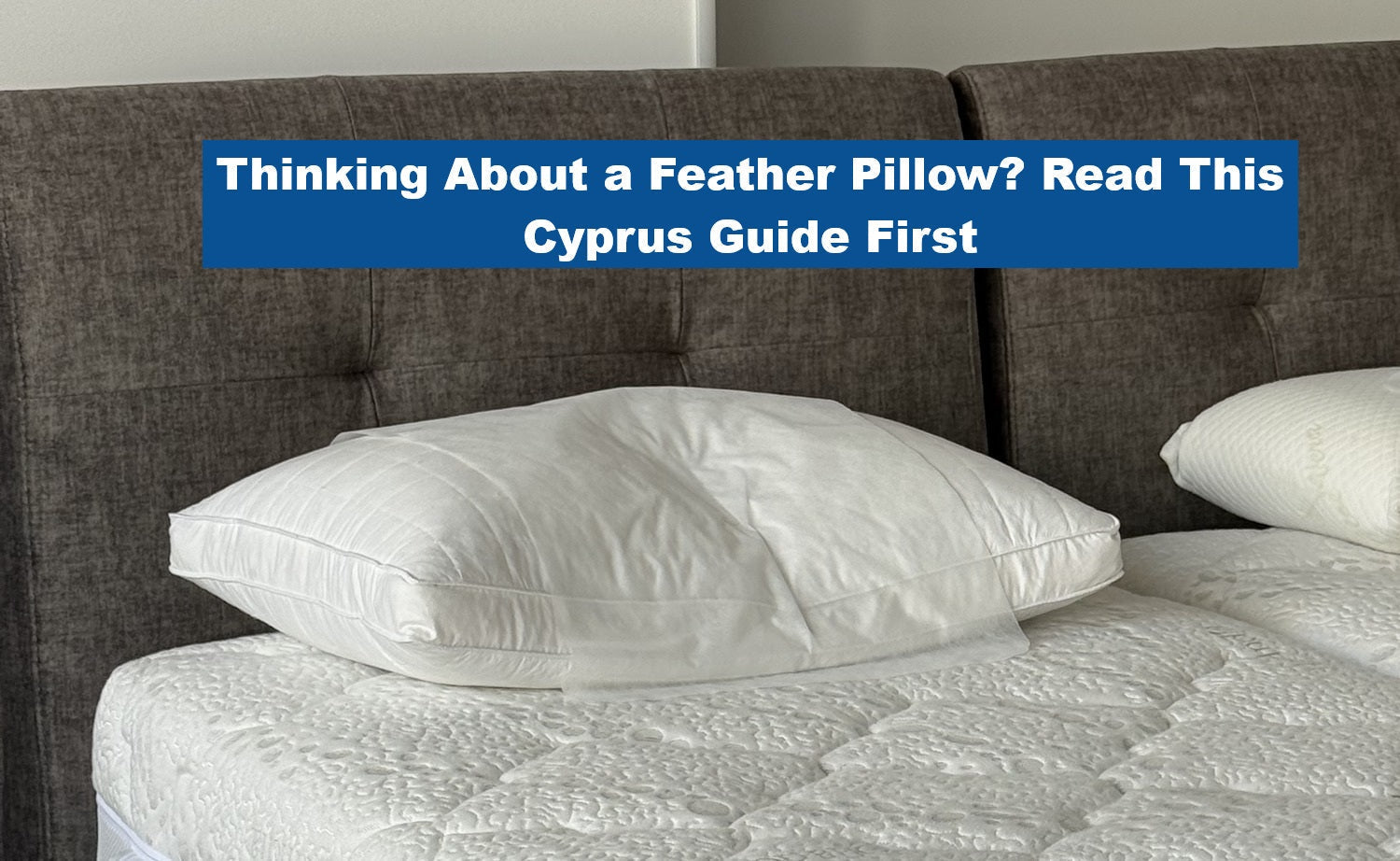
A feather pillow is filled with the outer feathers of waterfowl, encased in a tightly woven cotton shell. Feather pillows suit Cyprus's Mediterranean climate for most of the year, offering natural breathability and superior moldability. Choose an OEKO-TEX Standard 100 or RDS-certified pillow with a shell of at least 200 thread count, and wash it every three to six months on a gentle cycle.
Choosing the right pillow matters more than most people realise. The fill material determines how much support you receive, how the pillow breathes overnight, and how long it holds its shape before it needs replacing. Across Cyprus, feather pillows remain a popular choice for their natural comfort and cost-effectiveness relative to pure down alternatives.
This guide covers everything residents in Cyprus need to know: what feather pillows contain, how they compare to down pillows, whether they suit the local climate, how to select the right one, and how to care for it properly.
What Is a Feather Pillow?
A feather pillow is a type of bedding pillow filled primarily with the outer feathers of waterfowl, most commonly ducks or geese, and enclosed in a tightly woven fabric shell. The term distinguishes this category from down pillows, which are filled with soft clusters of down that lie beneath the bird's outer feathers.
What Is Inside a Feather Pillow?
The interior of a feather pillow consists of outer contour feathers from ducks or geese, each containing a central stalk known as a quill. These quills give the feather its characteristic firmness and structure. Most commercially sold feather pillows use a blend rather than pure feather fill, typically mixing a percentage of down clusters with the feathers to improve softness.
The shell encasing the fill plays an equally important role. Feather quills are stiff and can poke through fabric, so manufacturers use shells with a thread count of at least 200, often constructed from downproof cotton or cambric. The tighter the weave, the less likely a quill will penetrate the casing and irritate the sleeper.
How Are Feather Pillows Made?
Feather pillow manufacturing follows a sequence of collection, cleaning, and encasing. Feathers are harvested primarily as a by-product of the food industry, after which they undergo multiple cleaning cycles involving washing, sterilising, and drying at high temperatures to remove dust, oils, and biological material. Certified products such as those bearing the Responsible Down Standard (RDS) trace this process from farm to finished product, verifying that no live plucking or force-feeding occurred during sourcing.
Once cleaned, the feathers are blown or hand-filled into pre-sewn pillow shells. The shell is then sealed with double-stitched seams to prevent fill from escaping. Higher-quality production processes include an inner baffle or secondary liner to further contain the feathers and reduce poke-through.
What Are the Differences Between Feather and Down Pillows?
Feather and down pillows originate from the same birds but use entirely different parts of the plumage, producing distinct sleeping characteristics.
1. Feather Pillows
Feather pillows contain quills, which create a firmer, denser sleeping surface. This firmness makes them better suited to back and stomach sleepers who prefer a flatter profile. The heavier weight of feathers compared to down means these pillows compress more predictably under pressure. Their lower cost makes them an accessible entry point into natural-fill bedding, with most quality feather pillows priced significantly below comparable pure down options. One limitation worth noting: quills can shift and occasionally poke through shells, particularly in lower thread count covers.
2. Down Pillows
Down pillows use the fluffy, quill-free clusters found beneath the outer feathers of waterfowl. These clusters trap air efficiently, producing a lighter, warmer, and softer pillow than feather fill alone. Down fill power ranges from 300 to 900 cubic inches per ounce, with anything above 650 considered premium quality.
Because down clusters lack rigid quills, they reshape more fluidly to the sleeper's head position. The trade-off is cost: high fill power goose down pillows cost considerably more than comparable feather pillows.
|
Property |
Feather Pillow |
Down Pillow |
|
Fill source |
Outer contour feathers with quills |
Soft clusters beneath outer feathers |
|
Softness |
Moderate |
High |
|
Support |
Firmer and more structured |
Softer, less supportive |
|
Weight |
Heavier |
Lighter |
|
Insulation |
Moderate |
High |
|
Fill power rating |
None (feathers have no fill power) |
550–900 cubic inches per ounce |
|
Price |
Lower |
Higher |
|
Maintenance |
Similar washing requirements |
Similar; requires thorough drying |
Are Feather Pillows Good for Cyprus?
Feather pillows are well-suited to Cyprus's climate for most of the year, with particular advantages during the mild autumn and winter months. Understanding how the local climate interacts with fill material helps narrow the choice.
Cyprus has a Mediterranean climate characterised by very hot, dry summers and mild, wet winters. Average annual temperatures reach 17.5°C, with summer highs in Nicosia regularly exceeding 38°C. Relative humidity drops significantly in summer, falling to between 15% and 30% near midday on the central plain, according to Visit Cyprus, before rising to between 60% and 80% during winter months.
These conditions affect pillow performance in two distinct ways. During summer, low humidity reduces the moisture-trapping risk associated with natural fills, and feathers' moderate breathability performs adequately. During winter, the mild temperatures mean heavy insulation is rarely required, so feather's moderate warmth rating suits the season without overheating.
Sleepers who benefit most from feather pillows in Cyprus include those who prefer a firmer, adjustable support surface, those who want natural fill at a lower price than pure down, and those sleeping in air-conditioned bedrooms where temperature regulation matters less.
Those who may find feather pillows less suitable include allergy sufferers sensitive to feather proteins, sleepers who run warm year-round without air conditioning, and those who prioritise maximum softness above all.
What Are the Benefits of Feather Pillows for Cyprus?
Feather pillows offer a distinct set of benefits that make them a practical choice for households across Cyprus.
-
Natural moldability stands as one of the most appreciated qualities. Feather fill reshapes around the head and neck each time the sleeper shifts position, providing a customised contour that most synthetic fills cannot replicate. This adaptability delivers pressure relief across different sleep positions.
-
Breathability is another meaningful benefit. Natural feathers allow air to circulate through the pillow, helping to dissipate heat and moisture overnight. During the transitional seasons of spring and autumn in Cyprus, this ventilation characteristic maintains a comfortable sleeping temperature without the need for cooling products.
-
Durability represents a further benefit. A quality feather pillow, maintained correctly, lasts five to ten years, outperforming most synthetic-fill alternatives. The natural resilience of feather fill means the pillow retains its loft longer when fluffed regularly.
What Are the Disadvantages of Feather Pillows in Cyprus?
The primary disadvantages of feather pillows relate to allergen sensitivity, quill poke-through, and maintenance demands. No fill material is universally ideal, and feather pillows carry specific limitations buyers should factor in.
-
Allergen response is the most frequently cited concern. Some individuals react to feather proteins rather than to dust mites, though certified pillows that are thoroughly sterilised during manufacture carry lower allergen loads. Sleepers with confirmed feather sensitivity should consider a hypoallergenic alternative.
-
Quill migration is a structural limitation. Over time, feathers shift inside the casing, and individual quills can work through the shell fabric, particularly when the thread count is low or the seams weaken with age. A pillow protector reduces this risk and extends the shell's lifespan.
-
Feather pillows also require more thorough drying than synthetic-fill pillows. Trapped moisture within feather fill creates conditions for mildew growth and unpleasant odours. In Cyprus's humid winter months, this demands careful attention to the drying process after each wash.
Finally, feather pillows do not hold a fill power rating. Fill power measures only pure down clusters, meaning feather-fill quality is harder to compare objectively across brands.
How Do You Choose the Best Feather Pillow for Cyprus?
Choosing the best feather pillow for Cyprus requires evaluating fill composition, shell quality, size, and certification. No single factor determines quality; the combination of these attributes defines the pillow's overall performance.
-
Fill composition: Check the ratio of feather to down on the product label. A 70/30 or 75/25 feather-to-down blend delivers better softness than pure feather fill while keeping costs lower than pure down options. Pure feather fill (100%) produces the firmest result and suits stomach sleepers who prefer a flat, low-loft pillow.
-
Loft and firmness: Loft refers to the height and fluffiness of the pillow. A higher fill weight within the same shell size produces a firmer result. Side sleepers generally benefit from a higher loft to fill the gap between shoulder and head. Back sleepers perform well with medium loft. Stomach sleepers require low loft to avoid neck strain.
-
Shell thread count: Select a shell with a thread count of at least 200, constructed from downproof cotton. Thread counts below this level allow quill penetration, reducing comfort and shortening the pillow's useful life.
-
Stitching: Double-stitched and box-stitched seam construction retains fill more evenly and prevents feathers from shifting into corners. Avoid pillows with a single-seam border construction, as these compress and redistribute fill unevenly over time.
Certifications: Look for the below specific marks.
-
OEKO-TEX Standard 100: Confirms the shell fabric and fill have been tested for harmful substances.
Buying checklist:
-
Fill composition stated clearly on the label (e.g., 75% feather, 25% down)
-
Shell thread count of 200 or above
-
Downproof cotton shell construction
-
Double or box-stitched seams
-
OEKO-TEX Standard 100 certification
-
RDS certification for ethically sourced fill
-
Correct size for existing pillowcases
What Are the Feather Pillow Sizes Available in Cyprus?
Cyprus follows European standard pillow sizing, consistent with the rest of continental Europe. The most common sizes available from Cypriot bedding retailers are as follows:
|
Size Name |
Dimensions |
Best Suited For |
|
Small |
40 × 60 cm |
Children's beds, decorative use |
|
Standard |
50 × 70 cm |
Single and double beds |
|
Large |
50 × 90 cm |
King-size and double beds |
|
Square (Euro) |
65 × 65 cm |
Decorative arrangement, continental preference |
|
Body pillow |
40 × 140 cm |
Pregnancy support, side sleepers |
The 50 × 70 cm standard size is the most widely sold format in Cyprus and fits the majority of pillowcases available locally. The 65 × 65 cm square format is common in central European households and often used decoratively at the head of made beds.
Before purchasing, confirm your existing pillowcases match the intended pillow dimensions, as a size mismatch causes cover distortion and accelerates fabric wear.
How Do You Care for and Maintain a Feather Pillow?
Caring for a feather pillow correctly involves regular washing, thorough drying, daily fluffing, and protective covering. Each of these steps directly affects lifespan and hygiene.
Wash feather pillows on a gentle or delicate machine cycle using cool or warm water. Never use hot water, as it breaks down the feather structure and can cause clumping. Use a mild, low-sudsing detergent formulated for delicates or natural fills. Avoid bleach and fabric softener; bleach degrades the feather proteins, and softener coats the fill and reduces breathability. Running an extra rinse cycle removes all soap residue, which otherwise causes odour when the fill dries.
For drying, place the pillow in a tumble dryer on the lowest heat setting. Add two clean tennis balls or wool dryer balls to the drum to break up clumps and redistribute the fill as it dries. Complete drying typically requires two to three full dryer cycles. Removing the pillow periodically to fluff it manually speeds the process. Never store or use a feather pillow that has not dried completely, as residual moisture produces mildew.
Between washes, fluff the pillow every morning to restore its loft and promote air circulation through the fill. Airing the pillow outdoors on a dry day, away from direct harsh sunlight, refreshes the fill naturally. Store spare feather pillows in breathable cotton bags, not plastic, which traps moisture and accelerates fill degradation.
A pillow protector placed beneath the pillowcase creates a barrier against sweat, skin oils, and dust mites, reducing how frequently a full wash is necessary and extending the useful life of both the shell and fill.
How to Deodorise Feather Pillows?
The most effective method for deodorising a feather pillow is tumble drying it on low heat for 15 to 20 minutes with two dryer balls, which disrupts the fill and allows heat to circulate through the casing. For persistent odours, airing the pillow outdoors on a dry, breezy day for two to three hours removes the majority of absorbed smells. Full washing resolves odours that airflow alone does not eliminate.
How Often Should You Wash a Feather Pillow?
Feather pillows should be washed every three to six months under normal use conditions. Households using a pillow protector can extend this interval to six months, as the protector absorbs the majority of body oils and moisture before they reach the fill. Without a protector, washing every three months maintains hygiene standards. Visible staining or persistent odour warrants an immediate wash regardless of schedule.
How Long Do Feather Pillows Last in Cyprus?
A quality feather pillow lasts between five and ten years with proper maintenance. In Cyprus's climate, the principal longevity risks are moisture retention during humid winter months and heat exposure during storage in warm months. Both accelerate fill degradation and shell fabric wear.
A simple lifespan test involves folding the pillow in half and releasing it. A pillow that does not spring back promptly has lost structural integrity and should be replaced. Keeping the pillow in a breathable cover, washing it regularly, and drying it completely after each wash maximises time to replacement.
Where Can You Buy Feather Pillows in Cyprus?
Feather pillows are available from bedding specialists, furniture retailers, department stores, and online shops operating across Cyprus.
For buyers who want in-store expertise, Panstromasew is a dedicated bedding and sleep specialist with a physical presence in Cyprus and an online store delivering across the island.
Panstromasew stocks a curated range of pillows from established brands including Aeroflex, Auping, and Hollandia, alongside mattresses, linen, and sleep accessories. The store offers free shipping on orders above €25 within Cyprus and provides direct access to product specialists who can advise on fill composition, size, and certifications.
Beyond specialist retailers, furniture showrooms and home department stores in Nicosia, and Limassol, stock feather and feather-blend pillows at varying price points.